


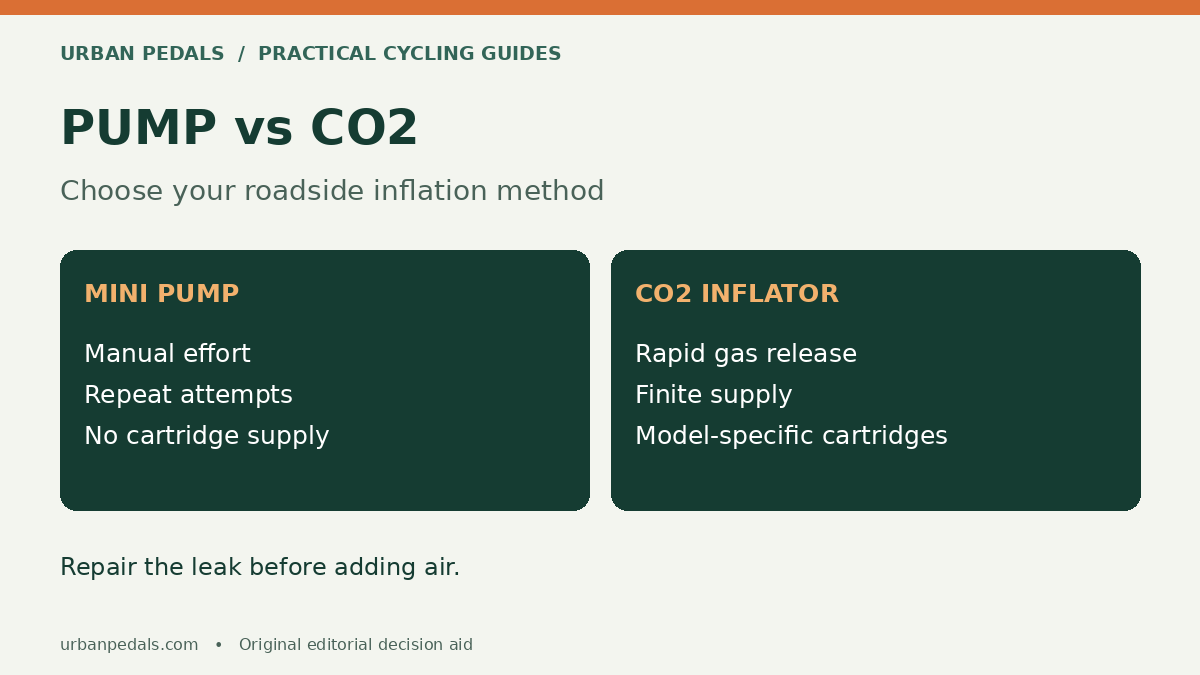
A mini pump is the practical default when you want repeatable roadside inflation without replacement cartridges. A CO2 inflator can save time, but every attempt uses a finite supply. Carrying both can make sense when speed matters and you still want a fallback.
Compare the tradeoffs
| Question | Mini pump | CO2 inflator |
|---|---|---|
| Can you try again? | Yes, while the pump works | Only while enough gas remains |
| What powers it? | Manual effort | A compatible cartridge |
| What needs practice? | Stable valve connection and pumping | Connection sequence and controlled release |
| What must you restock? | Normally no inflation consumable | Used cartridges |
| Main packing tradeoff | Length, effort and inflation time | Finite supply and extra consumables |
This comparison is a decision aid, not a timed product test. Performance varies substantially between models and tire sizes. A small pump designed for high pressure may be tedious on a large-volume tire; an advertised maximum pressure does not tell you how easy the pump is to use.
Check four compatibility points
- Valve: confirm the head fits your actual valve.
- Tire: check whether the system suits your tire volume and required pressure.
- Cartridge: verify the inflator’s accepted cartridge type and size.
- Tubeless system: follow the sealant and repair-system instructions for CO2 use.
Not every product described as a CO2 tool inflates through a valve. For example, Lezyne states that its Tubeless CO2 Blaster requires a separate head to inflate through Presta or Schrader valves. Read the exact product instructions rather than relying on a category label.
A pump does not fix a puncture
Repair the air leak before inflation. If you use tubes, inspect and repair or replace the tube as appropriate. A tubeless tread puncture may be repairable using the approved system, while major casing damage needs a different response. Do not repeatedly empty cartridges into a tire that still has an unresolved leak.
Build the complete setup with our commuter bike repair kit checklist. If the valve connection is unfamiliar, use the Presta and Schrader guide before experimenting beside the road.
Using CO2 requires preparation
Follow the inflator’s instructions for attaching the cartridge and controlling gas flow; the order differs between designs. Discharging cartridges become very cold, so use the supplied protective sleeve or the protection specified by the maker. Do not direct escaping gas at yourself or others.
Do not assume one cartridge produces a particular pressure in every tire. Tire volume, cartridge size, leakage and the starting pressure change the result. Check pressure with suitable equipment. REI advises replacing CO2 in the tube with air after the ride; follow your tire-system instructions when doing so.
Which setup fits your riding?
Daily commuting: prioritize a pump you can use reliably and store securely. Remote touring: repeat attempts and independence from cartridge supply make a pump especially valuable. Time-sensitive rides: CO2 may be a useful addition after you have practiced with it.
Test your chosen system at home, then write down any missing parts. Pack an inflation method, repair materials and the tools required to remove your wheel. Our bicycle tool kit guide helps separate those essentials from workshop equipment you can leave at home.
Sources and further reading
Editorial note: This is a research-based guide, not a hands-on product test. Check the instructions for your exact bicycle and components before maintenance.



Leave a comment